Google has never penalised a page for being written with AI; it penalises pages that add nothing, and its spam policies target scaled content abuse rather than who typed the words. For PR agencies in Australia and the UK, the durable advantage is original client data published as plain, visible text near the top of a page, where AI answer engines can actually read it.
The story that reached most agency principals this month ran roughly like this: AI text now carries a hidden fingerprint, regulators are about to demand it, and every page your team drafted with a model is waiting to be found out. The first half is true. The second half has never been Google's position, and it is not the law in Australia or the United Kingdom.
What should worry a PR agency is duller and more expensive. Commodity output at volume is the real exposure, and the hedge against it is already on your server: the client research your team ran last quarter and published as a PDF nobody, and nothing, can read.
The watermark is real. It is also not your problem.
On 11 August, Anthropic confirmed that Claude's text carries an invisible watermark, and that every model it has released since 2 August marks its own output. The mechanism is the interesting part, as Search Engine Land set out: the signature lives in word choice, because the model is biased toward a secret half of the vocabulary. So it is not metadata a CMS strips on upload. Copy the text out of the chat, paste it into your CMS, and the signature travels with it. (Search Engine Land is owned by Semrush, which also ran one of the studies below.)
The same piece notes the EU AI Act's transparency code took effect on 2 August and requires AI-generated content to be marked so other systems can identify it. The European Commission's FAQ on the Article 50 obligations dates it precisely: Article 50 applies from 2 August 2026, with a grace period to 2 December 2026 for the marking duty where a generative system was already on the market. And the text of Article 50 is unambiguous about who carries it. Providers of AI systems generating synthetic text must ensure outputs are marked in a machine-readable format. Your agency is not the provider. Anthropic and OpenAI are.
What Google actually polices is value, not authorship
Search Engine Land's write-up of Google's position makes the distinction that matters. Google put that position in writing in February 2023 and has not moved since: content is just content. Rather than play detector against generator, it drew the line at whether a page adds anything a searcher would value. The spam policies are built the same way. There are 16 of them, generative AI appears twice in the entire document, and the instance that matters sits inside scaled content abuse: many pages, no added value, built to move rankings. A hundred human freelancers churning out thin pages breaks that rule exactly the way a prompt loop does.
The most-quoted cautionary tale holds up under that reading. In November 2023 an SEO founder turned a competitor's sitemap into article titles, generated roughly 1,800 pages from them, and published a running total of 3.6 million visits at 490,000 a month. The post announcing it did 4 million views. Within months the gains had largely evaporated and the site sat back around where it started.
Semrush's study of 42,000 blog posts, reported in the same piece, looks at first glance like the counter-argument. Semrush graded those posts with an AI detector and sorted them by ranking position: at Position 1, pages came back 80.5% likely human-written and around 10% likely AI, and human content took the top spot roughly eight times more often. The researchers cautioned against reading that as proof AI cannot rank, and they were right to. A detector reads the finished product, and a page somebody genuinely worked on reads like one even when a model helped draft it. In April, at Search Central Live in Toronto, Google's Danny Sullivan gave the non-commodity column three words: unique, specific, and authentic. Volume without value is what gets hit, whoever produced it.
The asset your agency already produces and keeps throwing away
A PR agency has a structural advantage over almost every other content shop, because original data is a by-product of work you are already paid for. Client surveys, campaign results, omnibus questions, sector benchmarks. No industry body publishes a reliable figure for how many Australian or British agencies run proprietary research programmes, so treat that as reasoning rather than a statistic. The logic holds anyway: the marginal cost of publishing a finding you already commissioned is close to zero. And NP Digital's analysis of original data and AI citations argues models have an oversupply of the same recycled statistics, so a page contributing a new finding beats one summarising what already circulates.
Australia has a usefully unglamorous proof. Starworks, a business directory founded by a 17-year-old Melbourne student, appeared 199 times across 2,400 AI responses in a September 2026 Search Scope study, making it the third most-observed domain after Google and Reddit, ahead of Word of Mouth, ProductReview and hipages. Founder Ben Adler is blunt about it: "If you're not on the directories in the first place, your site is never even going to be looked at by ChatGPT." Brand size was not the variable. Structured, visible, locally owned data was.
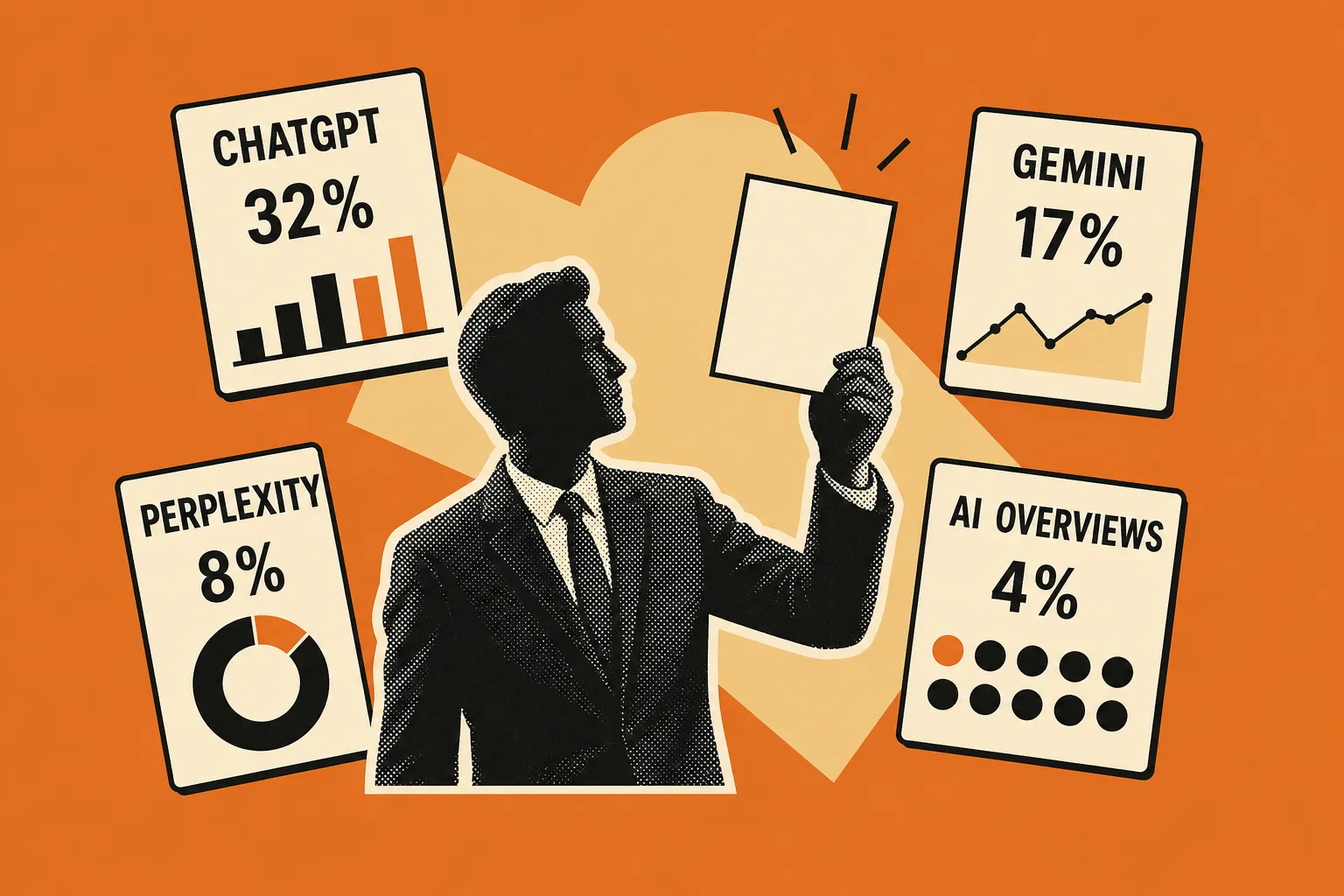
Size the opportunity honestly before you sell it. Optimising's GA4 study of 115 Australian businesses across 24.8 million sessions found ChatGPT accounting for 90.2% of AI website visits in Australia, the share of projects receiving any AI traffic rising from 13.5% in 2023 to 88.5% in 2025, and AI still worth roughly 0.1% of e-commerce revenue. That is first-party agency data authored by its own founder, so weight it accordingly. The read is positional: near-universal presence, negligible dollars, which is exactly when a citable asset is cheap to build. Start with ChatGPT's brand visibility.
Measurement points the same way. The PRCA's 2025 UK census, based on a OnePoll survey of PRCA members, found AVEs still in use by 37% of practitioners against 38% using the Integrated Evaluation Framework. An agency still reporting advertising value equivalents has a harder conversation ahead of it than one showing defensible AI-visibility metrics to a board or explaining how assistants describe the client. Our earlier work on digital PR and AI brand citations covered the links-and-mentions side; owned data is the other half, and the reason being recommended now matters more than being ranked. As Australian practitioner Nick Brogden argued in Startup Daily's piece on where the AI citation opportunity sits: "They'll win because they've answered the hardest questions first." A commissioned survey is, by definition, an answer nobody else has.
Turning a client survey into a page an AI answer can lift
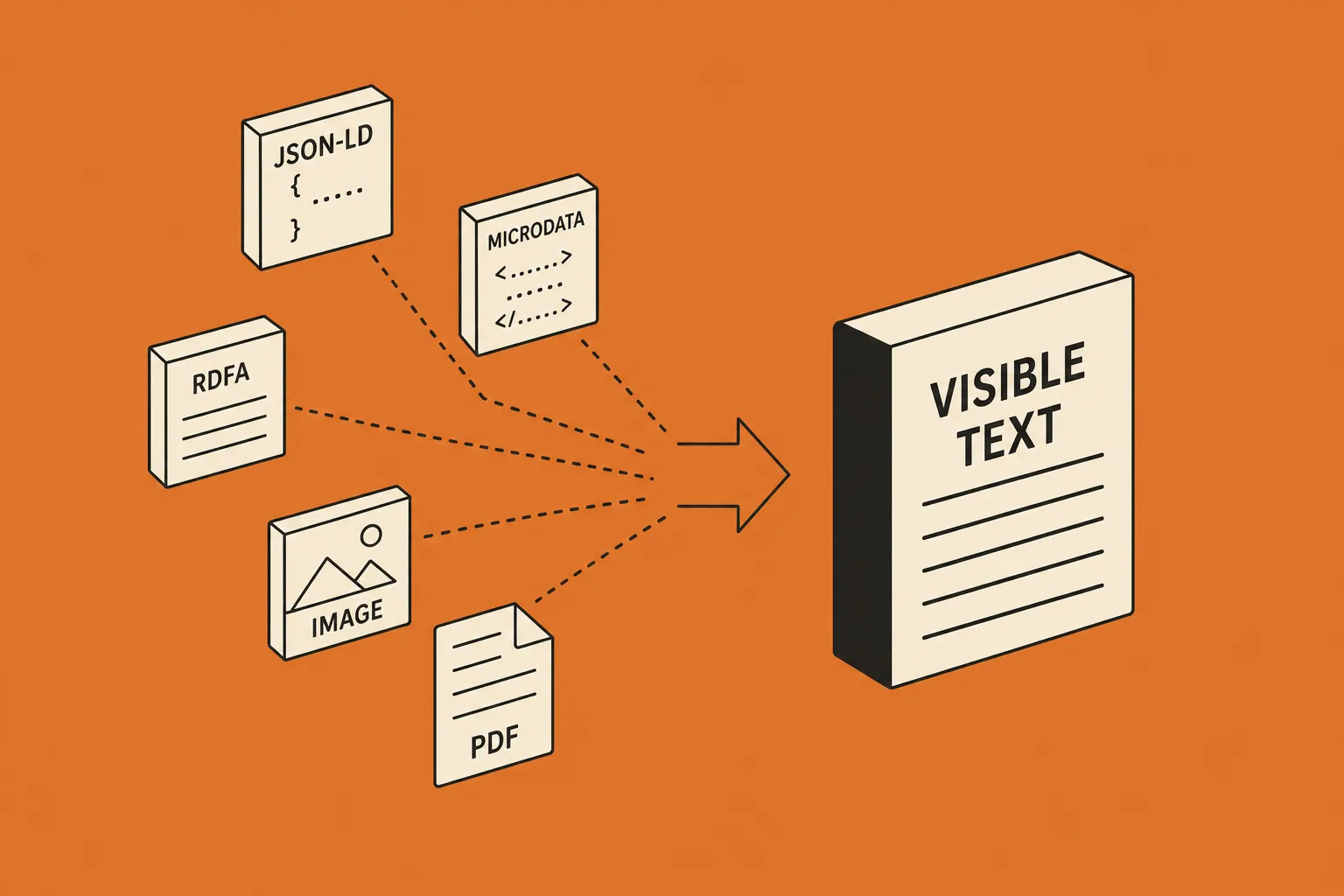
Most agencies publish original research the way a newsroom would post a media release in a sealed envelope. The content is fine. The container defeats it. Ahrefs tested five major AI systems and found they ignored JSON-LD, hidden Microdata and hidden RDFa, reading visible HTML instead. A finding that exists only inside a chart image, or only inside a gated PDF, is not a weak signal. It is no signal. (The vocabulary for this work is still contested: GEO, AEO and AI search visibility describe roughly the same activity, and Google's stated position is that good SEO already covers most of it. Treat the label loosely and the mechanics literally.)
Four changes convert a research asset into a citable page, and none needs a rebuild. State the headline finding in the first screen under a specific H2, which matches NP Digital's recommendation to surface important original statistics within roughly the first third of educational and commercial pages. Put method and sample size in plain text directly beneath it, as running prose. Use the chart as illustration rather than container, so every number in the graphic also exists as text. And keep one stable URL you update annually, instead of minting a new PDF each year and orphaning last year's citations. That last one is the content-production discipline most agencies skip, and it compounds.
One real Australian caveat sits underneath this. The OAIC's guidance on commercially available AI products advises organisations not to enter personal information, particularly sensitive information, into publicly available AI tools, and notes that APP 6 limits secondary use beyond the purpose of collection. Publish the aggregate, keep respondent-level data out of the chat window, and say so in the method line.
What to say when the client asks "will AI know we wrote this?"
Let's take the regulatory question in the order a client actually asks it.
Australia has no standalone AI Act and no mandatory labelling rule. The National AI Plan encourages businesses and content creators to label AI-generated material through visible notices, watermarking and metadata, then stops short of actually requiring this disclosure. The relevant guidance sits in the non-binding Voluntary AI Safety Standard, whose Guardrail 6 covers informing end-users about AI-generated content. That absence is a settled choice: in the same plan the government decided against the mandatory high-risk guardrails it had previously explored. Nor does the pending legislation touch content marking. The Prime Minister's July 2026 announcement of Australian Standards for AI is projected to reach Parliament in 2027, and its substance concerns large AI data centres and protecting creative works from training without consent.
The UK position matches. DSIT's March 2026 report on copyright and artificial intelligence states plainly that there are no obligations in the UK for AI-generated content to be labelled, with the next step framed as working with industry on best practice. Reed Smith's review of UK and EU AI transparency reached the same conclusion in February 2026, so date-stamp the claim when you repeat it.
The EU is the one place to be careful, and only narrowly. Article 2 of the AI Act extends scope to deployers located in a third country where the output is used in the Union, so "we're in Sydney" is not a blanket answer. Even then, the deployer-side text duty attaches to material published to inform the public on matters of public interest, and it does not apply where the content has undergone human review or editorial control and a person holds editorial responsibility. The Commission defines that review as deliberate examination of the substance by people with relevant knowledge and professional judgement, which a spell-check does not satisfy. Ordinary commercial content sits outside the trigger. This is legal information rather than legal advice, and a client running EU-facing public-interest campaigns should take its own.
So the next client call has a straight answer. No Australian or UK regulator requires you to declare AI assistance, no Google policy punishes it, and the one marking obligation that exists belongs to the model providers. The better question is whether the page says something only that client could say.
Key takeaways
- The Article 50 marking duty sits with model providers, not with the agency publishing the text. Stop selling AI-detection anxiety, and stop buying it.
- Google's exposure is scaled content abuse: many pages, no added value. The 2023 SEO heist failed on volume, not on provenance.
- Your client survey is the cheapest citable asset available to you, because you were already paid to produce it.
- Move the headline finding into the first third of the page, put method and sample size in visible text, treat the chart as illustration rather than container, and keep one stable URL you update annually.
- Publish the aggregate and keep respondent-level personal information out of public AI tools, in line with OAIC guidance.
Frequently asked questions
What is PR SEO?
PR SEO is the practice of building earned-media work so it also produces durable search and AI-answer visibility, rather than a spike in coverage that disappears. In practice it means publishing original client data and research on owned pages in a format search engines and AI assistants can read, then earning the coverage that points back to it.
What is digital PR?
Digital PR is public relations executed for online discovery: securing coverage, mentions and links from publications that influence how a brand is found and described online. The measurable output has shifted from clippings and advertising value equivalents toward links, branded search and whether AI assistants name the brand when asked about its category.
Does Google penalise content written with AI?
No. Google's published position since February 2023 is that content is just content, and its spam policies target scaled content abuse, meaning many pages with no added value built to move rankings. A hundred freelancers producing thin pages breaks that rule the same way a prompt loop does, so the test is value rather than authorship.
Do Australian or UK agencies have to disclose AI-generated content?
No. As at early 2026 neither country imposes a labelling duty: Australia's National AI Plan encourages disclosure but stops short of requiring it, the Voluntary AI Safety Standard is non-binding, and DSIT has confirmed there are no UK obligations for AI-generated content to be labelled. The EU AI Act can reach a third-country deployer where the output is used in the Union, but its text obligation covers material informing the public on matters of public interest and carves out content under genuine human editorial review.
How do you get a client survey cited by an AI assistant?
Publish the finding as visible text near the top of a page, not inside an image or a gated PDF. Ahrefs found five major AI systems ignored JSON-LD, hidden Microdata and hidden RDFa and read visible HTML instead, and NP Digital recommends surfacing important original statistics within roughly the first third of educational and commercial pages.
About Amina
Amina helps professional-services firms get cited in AI answers, not just ranked in Google. We measure your share of AI visibility and build the content and structure that earn the citation. See Amina's AI SEO and visibility service.